

Why Is Logical Intelligence Important for Academic Achievement?
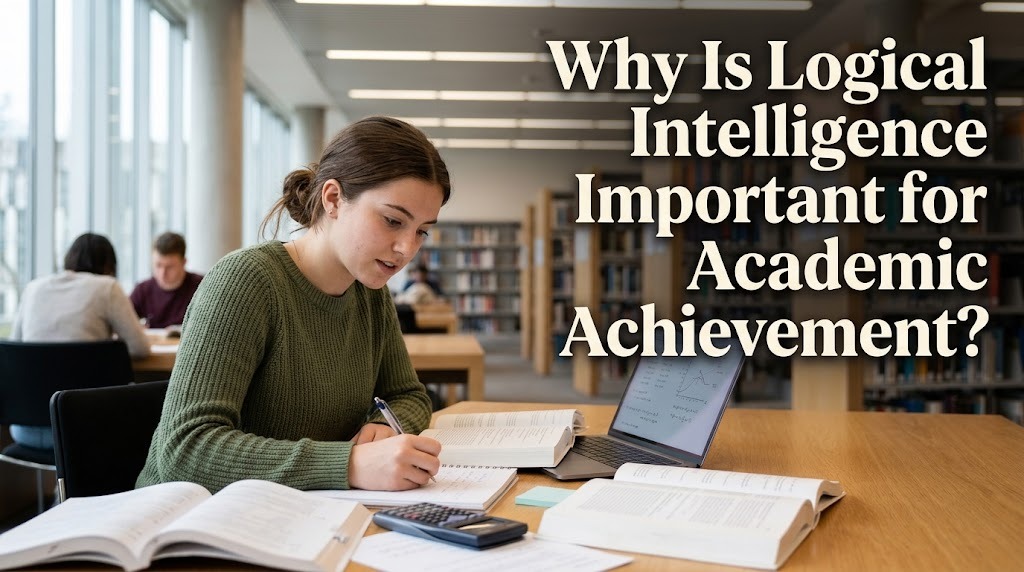
Academic achievement is influenced by many factors, including learning habits, motivation, discipline, and the ability to understand information. One ability that can support the learning process is logical intelligence. This intelligence helps students organize information, identify relationships, analyze problems, and develop reasonable solutions. It can be useful across different subjects because many academic tasks require students to understand concepts rather than simply memorize them. Developing logical intelligence can therefore help students approach their studies in a more structured and effective way.
UNDERSTANDING LOGICAL INTELLIGENCE IN EDUCATION
Logical intelligence refers to the ability to use reasoning, recognize patterns, analyze information, and understand relationships between different ideas. In education, this ability allows students to examine information carefully before reaching a conclusion. A student may use logical thinking when solving mathematical problems, analyzing scientific information, or understanding the causes and effects of an event. It also helps students identify which information is relevant when dealing with a complex assignment.
Logical intelligence is not limited to students who are good at mathematics. Reasoning and analysis are useful in many academic fields, including languages, business, technology, science, and social studies. For example, a student studying business may need to compare market information and determine possible solutions to a business problem. A language student may use logical thinking to organize arguments in an essay. This shows that logical intelligence can support different forms of academic learning.
HOW LOGICAL INTELLIGENCE SUPPORTS LEARNING
Logical intelligence can make learning more organized because students learn to connect new information with concepts they already understand. Instead of memorizing isolated facts, students can look for patterns, relationships, causes, and consequences. This approach can make complex topics easier to understand because information is placed into a meaningful structure. Students can also use logical reasoning to identify the main idea of a lesson and separate important information from supporting details.
Another benefit is that logical thinking encourages students to examine information step by step. When they encounter a difficult topic, they can divide it into smaller parts and study each part carefully. Breaking a complex problem into manageable steps can make the learning process less confusing. Students can then check whether their understanding is correct before moving to the next concept. This method can be especially helpful when studying subjects that require several connected ideas.
LOGICAL INTELLIGENCE AND PROBLEM SOLVING
Problem solving is an important part of academic achievement because students regularly face questions and assignments that require more than memorization. Logical intelligence helps students identify the problem, examine available information, and determine possible solutions. A systematic approach allows students to understand why an answer is correct, rather than simply choosing an answer based on guessing. This can improve their ability to handle different types of academic challenges.
Logical thinking also helps students evaluate the results of their work. After completing a problem, they can review the steps they used and identify possible mistakes. If an answer seems incorrect, they can return to the earlier steps and determine where the reasoning needs to be improved. Learning from mistakes is an important part of academic development because it allows students to improve their understanding. Over time, repeated practice can strengthen both problem solving and reasoning skills.
SUPPORTING CRITICAL THINKING AND DECISION MAKING
Academic achievement also involves the ability to evaluate information and make reasonable decisions. Students encounter information from textbooks, teachers, websites, social media, and other sources. Logical intelligence can help them compare information, examine evidence, and distinguish facts from unsupported conclusions. This is particularly important in the digital era, when students can access large amounts of information within a short time.
Logical intelligence can also support critical thinking when students participate in discussions or write academic assignments. Instead of accepting every statement immediately, students can ask whether an argument has sufficient evidence and whether the conclusion follows logically. They can consider different perspectives before forming their own conclusion. This habit of careful evaluation can improve the quality of academic work and encourage students to become more independent learners.
WAYS STUDENTS CAN DEVELOP LOGICAL INTELLIGENCE
Logical intelligence can be developed through regular activities that require reasoning and analysis. Students can practice with puzzles, strategy games, mathematics, coding, research activities, and analytical exercises. Reading different sources and comparing their information can also encourage students to examine evidence carefully. Another useful activity is explaining the steps behind an answer instead of providing only the final result. These habits encourage students to think more deeply about how they reach a conclusion.
Students can also develop logical thinking through everyday learning activities. Creating mind maps, organizing information, identifying patterns, and discussing possible solutions to a problem can provide useful practice. Teachers can support this development by giving students opportunities to ask questions and explain their reasoning. Consistent practice is more important than completing difficult activities occasionally. As students become more comfortable with logical reasoning, they may find it easier to approach academic tasks systematically.
CONCLUSION
Logical intelligence is an important ability that can support academic achievement because it helps students analyze information, understand relationships, solve problems, and evaluate conclusions. It can make learning more meaningful by encouraging students to understand concepts instead of relying only on memorization. Logical reasoning can also strengthen critical thinking and help students handle complex academic tasks. Although it does not guarantee academic success by itself, it can become a valuable part of effective learning.
Students can develop logical intelligence through consistent practice, problem solving, analytical activities, and careful evaluation of information. These skills can be applied across different subjects and can remain useful beyond school or university. By combining logical thinking with discipline, motivation, and effective study habits, students can build a stronger foundation for their academic development and future challenges.
Recent Posts

Bagaimana Sistem SKS pada Program Kuliah... 22.11.2026/12 View

How Does Technology Make Daily Evaluation... 21.11.2026/63 View

Apa Strategi Menghadapi Kesenjangan antara Kompetensi... 21.11.2026/64 View

Mengapa Inventaris Aset Penting bagi Kelancaran... 21.11.2026/61 View

When Should Musicians Join a Record... 21.11.2026/59 View
