

Why Is Mind Mapping Effective for Note-Taking?
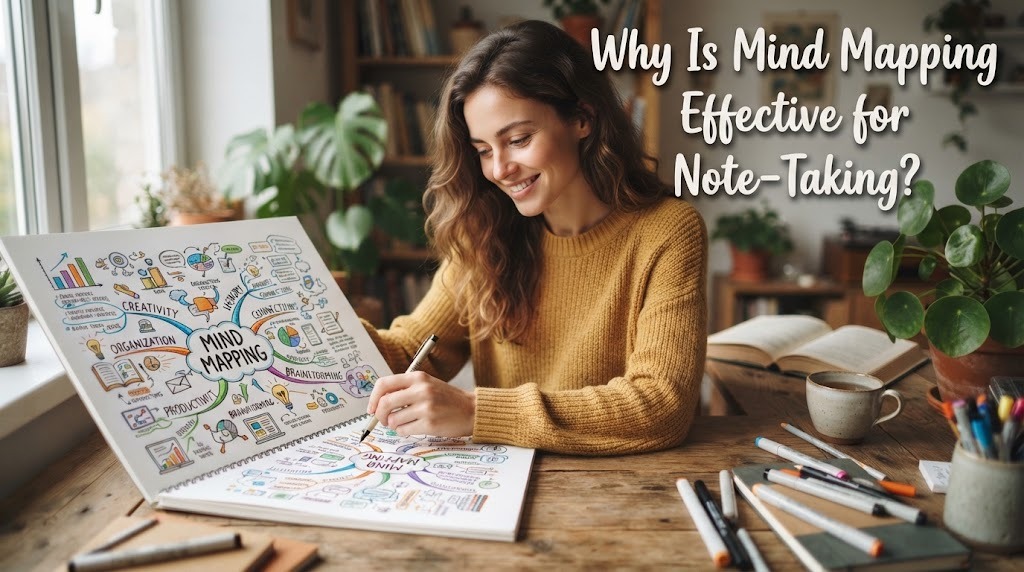
Mind mapping is a visual note-taking technique that organizes information around a central topic. Instead of writing information in long paragraphs, students use keywords, branches, lines, and connections to show how ideas relate to one another. This method can make complex information easier to understand and review. Mind mapping is especially useful for students who learn well through visual organization and connected ideas.
HELPS ORGANIZE INFORMATION VISUALLY
One major benefit of mind mapping is that it presents information in a visual structure. The main topic is placed in the center, while related ideas branch outward. This allows students to see the overall structure of a lesson at a glance.
Traditional notes often present information from top to bottom. A mind map can show several related ideas at the same time. This structure can make large amounts of information feel more organized and easier to understand.
SHOWS CONNECTIONS BETWEEN IDEAS
Mind maps are useful because they clearly show relationships between different concepts. Lines and branches can connect main ideas, supporting details, examples, causes, and effects. This helps students understand how pieces of information fit together.
For example, when studying a topic about memory, students could place “Memory” in the center and create branches for sleep, nutrition, stress, exercise, and concentration. Each branch can then contain smaller details. This creates a visual representation of how different factors relate to the main topic.
MAKES COMPLEX TOPICS SIMPLER
Some subjects contain many concepts that can be difficult to organize. Mind mapping can break these topics into smaller and more manageable sections. Students can focus on one branch at a time while still seeing how it relates to the main topic.
This can be particularly useful for subjects that contain classifications, processes, or multiple related concepts. Instead of remembering a long list, students can follow the structure of the map. This can make difficult material easier to approach and review.
SUPPORTS MEMORY
Visual organization can provide additional cues for remembering information. A mind map combines keywords, spatial relationships, branches, and sometimes images or symbols. These different elements can give the brain several ways to access the same information.
However, creating a mind map does not automatically guarantee better memory. Students benefit more when they actively select important information and understand the connections between ideas. Using the completed map for recall and review can make it even more useful.
ENCOURAGES ACTIVE LEARNING
Creating a mind map requires students to make decisions about what information is important. They need to identify the main topic, select key concepts, and determine how different ideas are connected. This makes mind mapping an active learning activity rather than simple copying.
Students also have to summarize information into short keywords. This process encourages them to think about meaning and relationships. As a result, mind mapping can support deeper engagement with the material.
MAKES REVIEW FASTER
A well-designed mind map can summarize a large topic on one page. Students can quickly look at the central topic and follow the branches to review important information. This can make revision more efficient, especially before a test or presentation.
The map can also be used for active recall. Students can cover parts of the map and try to recreate the missing information from memory. This turns a visual note into a practical study tool.
USES KEYWORDS INSTEAD OF LONG SENTENCES
Mind mapping usually relies on short keywords and phrases rather than complete paragraphs. This keeps the notes compact and reduces unnecessary information. Keywords can also act as reminders that help students reconstruct larger ideas.
For example, instead of writing a full paragraph about the benefits of exercise, a student might use keywords such as “blood flow,” “sleep,” “stress,” and “brain health.” These words provide quick reminders while keeping the mind map easy to read.
CAN INCLUDE COLORS AND IMAGES
Students can use different colors, symbols, or simple drawings to distinguish branches and highlight important information. These visual elements can make the map easier to scan and more engaging. Images can also provide additional associations with particular concepts.
However, decoration should not become the main purpose of the map. Too many colors or unnecessary drawings can make information harder to find. Visual elements work best when they have a clear purpose.
FLEXIBLE FOR DIFFERENT SUBJECTS
Mind mapping can be adapted to many types of lessons. Students can use it for history, science, business, languages, project planning, and other subjects. The structure can change depending on the type of information being studied.
For example, a history mind map can organize events by causes, people, dates, and effects. A science mind map can show processes and relationships, while a business mind map can organize products, customers, marketing strategies, and goals. This flexibility makes the technique useful in different learning situations.
HOW TO CREATE AN EFFECTIVE MIND MAP
Start by writing the main topic in the center of the page. Create branches for the major ideas and add smaller branches for supporting details. Use short keywords and connect related concepts with lines or arrows.
After completing the map, review it and remove unnecessary information. Make sure each branch has a clear connection to the central topic. Finally, use the map to explain the lesson from memory or create questions based on its main branches.
CONCLUSION
Mind mapping is effective for note-taking because it combines visual organization, keywords, connections, and active learning. It can help students simplify complex topics, understand relationships between ideas, and review information more efficiently. When students create and use mind maps actively, the technique can also support memory and recall. The most effective mind map is not necessarily the most colorful or detailed, but one that makes important information clear and easy to understand.
Recent Posts

Bagaimana Sistem SKS pada Program Kuliah... 22.11.2026/33 View

How Does Technology Make Daily Evaluation... 21.11.2026/67 View

Apa Strategi Menghadapi Kesenjangan antara Kompetensi... 21.11.2026/67 View

Mengapa Inventaris Aset Penting bagi Kelancaran... 21.11.2026/65 View

When Should Musicians Join a Record... 21.11.2026/66 View
