

Why Is Mind Mapping Suitable for Taking Notes on Complex Materials?
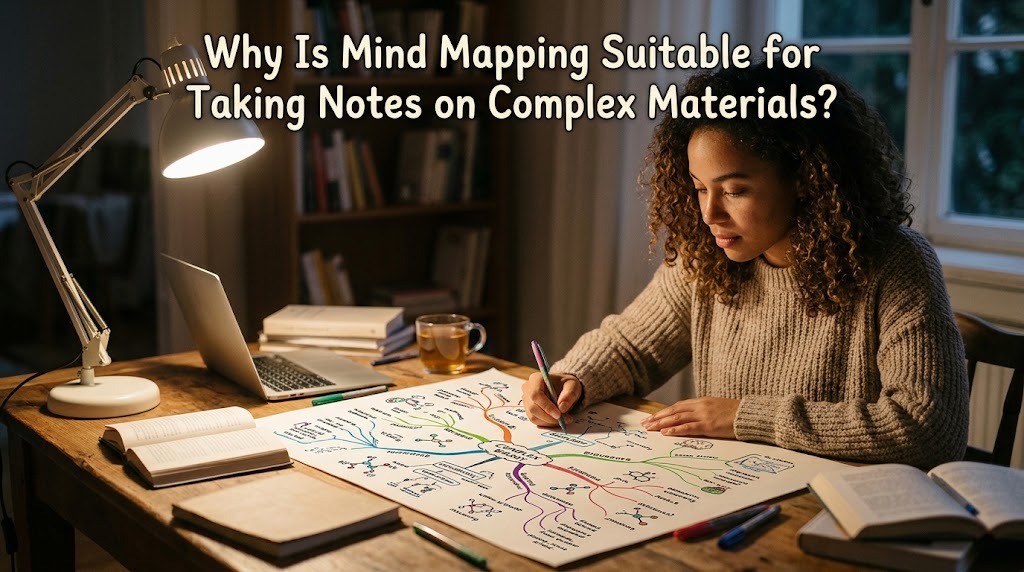
Complex learning materials often contain many concepts, details, processes, and relationships that students need to understand. Taking notes on this type of material can be challenging when information is written only in long paragraphs. Mind mapping provides a visual method that allows students to organize different pieces of information around a central topic. Through branches, keywords, and connections, students can create a clearer representation of complex subjects. This makes mind mapping a useful option for students who need to organize and review complicated learning materials.
ORGANIZES COMPLEX INFORMATION INTO CATEGORIES
One reason mind mapping is suitable for complex materials is that it can divide large topics into smaller categories. Students can place the main subject in the center and create major branches for important sections. Each branch can then contain supporting concepts, examples, definitions, or processes. This structure prevents all information from appearing as one large block of notes.
For example, when studying an economic system, students can create branches for types, characteristics, advantages, disadvantages, and examples. Each branch can be developed into smaller sections when necessary. This allows students to study one part of the topic without losing sight of the overall subject. The visual hierarchy can make complicated information easier to navigate.
SHOWS RELATIONSHIPS BETWEEN CONCEPTS
Complex subjects often involve relationships between different concepts. Mind mapping can make these relationships more visible by using branches, lines, and connections. Students can connect causes with effects, problems with solutions, or general concepts with specific examples. This helps them understand how different parts of a subject interact.
In traditional linear notes, these relationships may be separated across different paragraphs or pages. Students may need to read several sections before recognizing how the ideas are connected. A mind map brings related concepts into one visual structure. This can help students develop a broader understanding of the topic before focusing on individual details.
USES KEYWORDS TO REDUCE INFORMATION OVERLOAD
Complex learning materials can contain a large amount of information, and writing every sentence can make notes difficult to review. Mind mapping encourages students to use keywords and short phrases that represent important ideas. This can reduce unnecessary repetition and make the notes more concise. Students can then expand on the keywords when they need more detailed explanations.
Selecting keywords also requires students to identify the most important information from the material. They need to decide which concepts should appear as main branches and which should become supporting details. This process can encourage students to actively process the lesson instead of simply copying information. However, students should make sure that the keywords are accurate and meaningful.
MAKES REVIEWING DIFFICULT TOPICS EASIER
Mind maps can become useful review tools for difficult subjects. When information is arranged in one visual structure, students can quickly see the main topic and its supporting concepts. They can follow the branches to review specific sections without reading every note from the beginning. This can make revision more organized and focused.
Students can also use their mind maps to identify areas they do not understand. If a particular branch is incomplete or difficult to explain, they can return to the textbook, lecture material, or other reliable sources for clarification. After understanding the topic, they can update the map with the missing information. This creates a continuous learning process rather than a one-time note-taking activity.
SUPPORTS ACTIVE UNDERSTANDING
Creating a mind map requires students to analyze and organize information. They need to decide how different concepts are related and where each piece of information belongs. This can encourage deeper engagement with complex material. Students are not simply recording information but also creating a structure that represents their understanding.
Students can make this process more effective by explaining each branch in their own words. They can also close the map and try to recall the main concepts without looking at their notes. These activities can support active recall and understanding. Mind mapping is therefore most useful when students actively interact with the information rather than only focusing on the appearance of the map.
CAN BE ADAPTED TO DIFFERENT COMPLEX SUBJECTS
Another advantage of mind mapping is its flexibility. Students can use it for subjects involving processes, classifications, comparisons, causes and effects, or multiple related concepts. It can be created on paper or with digital tools, depending on the student's needs. The structure can also be changed as students gain a better understanding of the material.
However, not every type of information needs to be placed into a mind map. Detailed formulas, lengthy explanations, complete definitions, or step-by-step instructions may still require traditional notes or other formats. Students can therefore combine mind mapping with traditional notes, diagrams, practice questions, and summaries. Using different methods can help students handle complex materials more effectively.
CONCLUSION
Mind mapping is suitable for taking notes on complex materials because it helps students organize information, identify relationships, focus on keywords, and review difficult topics. Its visual structure allows large subjects to be divided into manageable sections without losing the connection between ideas. Students can also use mind maps to support active understanding and recall. However, mind mapping works best when combined with other study methods for information that requires detailed explanations. By using it appropriately, students can turn complex learning materials into a clearer and more manageable study structure.
Recent Posts

Bagaimana Sistem SKS pada Program Kuliah... 22.11.2026/27 View

How Does Technology Make Daily Evaluation... 21.11.2026/65 View

Apa Strategi Menghadapi Kesenjangan antara Kompetensi... 21.11.2026/65 View

Mengapa Inventaris Aset Penting bagi Kelancaran... 21.11.2026/62 View

When Should Musicians Join a Record... 21.11.2026/63 View
