

Why Is Primary Data Essential for Scientific Research?
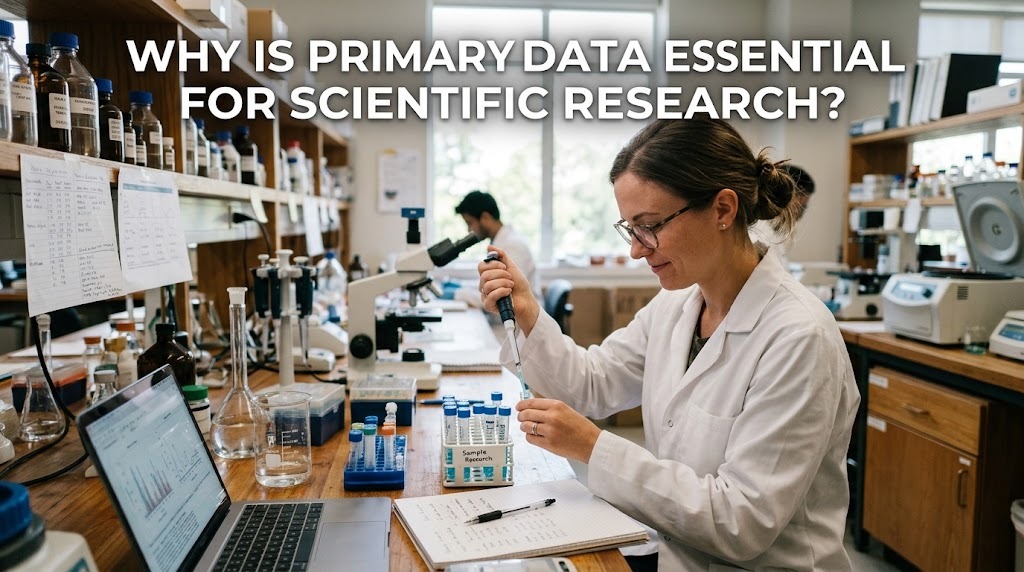
Scientific research depends on reliable evidence to explain phenomena, test hypotheses, and develop new knowledge. Researchers need information that directly addresses their research questions and supports careful analysis. Primary data plays an important role because it is collected firsthand through methods designed for a specific investigation. This information allows scientists to examine problems, test ideas, and evaluate whether their assumptions are supported by evidence. Understanding the importance of primary data helps explain how scientific research produces credible and meaningful findings.
PROVIDING ORIGINAL SCIENTIFIC EVIDENCE
Primary data provides original evidence gathered directly by researchers through experiments, observations, surveys, or measurements. Instead of relying entirely on previously published information, scientists can investigate a phenomenon using methods suited to their research objectives. For example, a biologist may record changes in plant growth under different environmental conditions. These observations provide direct evidence that can be analyzed to answer specific scientific questions. Original data is essential because it gives researchers a foundation for developing explanations and evaluating scientific claims.
TESTING HYPOTHESES AND SCIENTIFIC THEORIES
Scientific research often begins with a hypothesis that can be examined through observation or experimentation. Primary data allows researchers to compare their predictions with actual results and determine whether the evidence supports their expectations. For instance, a researcher investigating the effect of temperature on plant growth can measure growth under controlled temperature conditions. The collected measurements can then be analyzed to identify patterns or differences. This process helps scientists refine hypotheses, challenge existing explanations, and develop more accurate scientific understanding.
IMPROVING RESEARCH ACCURACY AND RELIABILITY
Collecting primary data allows researchers to establish procedures for measuring variables and recording observations. Standardized methods can reduce inconsistencies and make the research process easier to evaluate. Researchers can also check instruments, repeat measurements, and identify possible errors during data collection. These practices improve the reliability of the evidence and strengthen confidence in the analysis. However, primary data is not automatically accurate; its quality depends on appropriate research design, representative sampling, reliable measurements, and careful data management.
SUPPORTING NEW SCIENTIFIC DISCOVERIES
Scientific progress often requires information that existing studies have not yet provided. Primary data enables researchers to explore unanswered questions, investigate emerging problems, and examine phenomena under new conditions. For example, environmental scientists may collect water samples to assess pollution levels in a particular location. The results can reveal local conditions that broader studies might not capture. Such findings may contribute to new explanations, improved scientific models, or further research that expands existing knowledge.
ALLOWING RESEARCHERS TO STUDY SPECIFIC CONDITIONS
Scientific questions often involve particular populations, environments, or circumstances that cannot be fully represented by general datasets. Primary data allows researchers to collect information suited to these specific conditions. A public health researcher, for example, may gather data from a defined community to investigate local health patterns. This targeted approach helps researchers examine variables relevant to their objectives and understand differences between settings. Carefully selecting participants, locations, and measurement methods is important to ensure that the results are appropriate for the intended research question.
STRENGTHENING SCIENTIFIC VALIDATION AND REPRODUCIBILITY
Scientific findings become more credible when other researchers can examine the methods and assess the evidence supporting the conclusions. Properly documented primary data helps researchers explain how measurements were collected, how variables were defined, and how results were analyzed. When ethical, legal, and practical requirements permit, sharing data and research procedures can help other scientists verify findings or conduct related investigations. Repeated studies may confirm earlier results or reveal limitations that require further explanation. This process supports reproducibility and helps scientific knowledge develop through continued testing and evaluation.
SUPPORTING EVIDENCE-BASED DECISIONS
Primary data can provide important evidence for decisions in medicine, agriculture, engineering, environmental management, and other scientific fields. Researchers can use their findings to evaluate possible solutions, assess risks, and understand the effects of different interventions. For example, agricultural researchers may collect crop yield measurements to compare farming techniques. The results can help identify approaches worth investigating further or applying under suitable conditions. Effective decisions still require careful interpretation, consideration of uncertainty, and comparison with other relevant scientific evidence.
CONCLUSION
Primary data is essential for scientific research because it provides original evidence, supports hypothesis testing, and helps researchers investigate unanswered questions. It also contributes to accuracy, scientific validation, and evidence-based decision-making when collected and analyzed carefully. Although primary data requires time, resources, and appropriate research methods, it allows scientists to examine specific questions with greater control over the investigation. By maintaining rigorous procedures and transparent documentation, researchers can use primary data to produce credible findings and advance scientific knowledge.
Recent Posts

Bagaimana Sistem SKS pada Program Kuliah... 22.11.2026/46 View

How Does Technology Make Daily Evaluation... 21.11.2026/74 View

Apa Strategi Menghadapi Kesenjangan antara Kompetensi... 21.11.2026/75 View

Mengapa Inventaris Aset Penting bagi Kelancaran... 21.11.2026/72 View

When Should Musicians Join a Record... 21.11.2026/75 View
