

Why Is Reading Comprehension an Essential Part of Verbal Reasoning Tests?
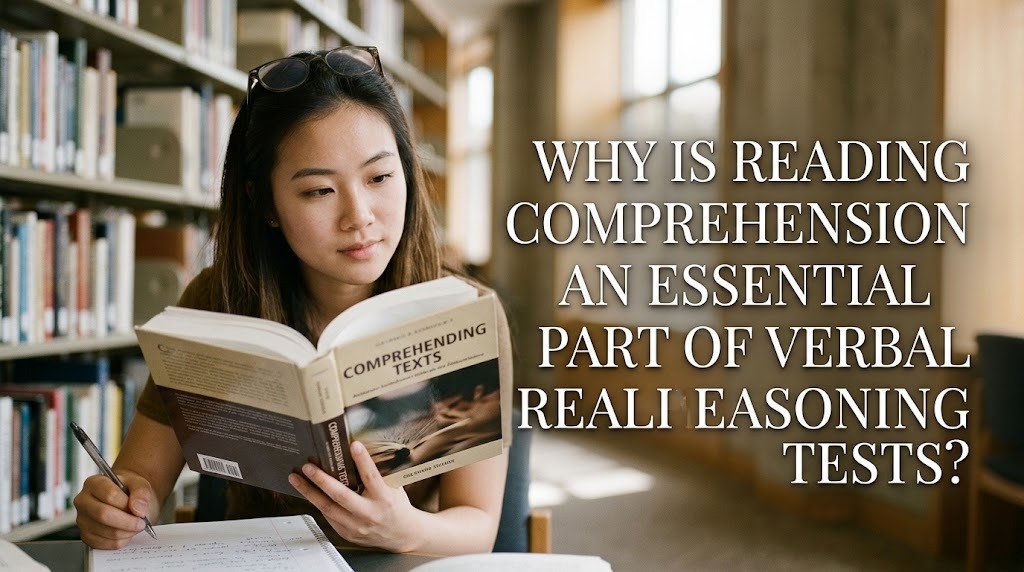
Reading comprehension is an essential part of verbal reasoning tests because it measures a person's ability to understand written information, identify important details, and draw logical conclusions from a passage. In academic assessments, university admissions, and job recruitment processes, candidates are often required to read different types of texts and answer questions based on the information provided. These activities evaluate how effectively individuals process language and understand the meaning behind written statements.
Having good reading comprehension skills can help candidates answer verbal reasoning questions more accurately and efficiently. It also allows them to recognize the main ideas, distinguish facts from opinions, and understand relationships between different pieces of information. Therefore, reading comprehension is not only important for achieving better test results but also supports academic learning, professional communication, and everyday decision-making.
UNDERSTANDING READING COMPREHENSION IN VERBAL REASONING
Reading comprehension refers to the ability to read, understand, interpret, and evaluate information contained in written materials. It involves more than recognizing individual words because readers must understand how sentences and paragraphs connect to communicate a particular message. In verbal reasoning tests, this ability is used to determine whether candidates can accurately interpret information and identify conclusions supported by a passage.
Candidates are generally given a short text followed by several questions. The questions may ask about the main idea, specific details, the author's purpose, or the meaning of particular statements. Some assessments also require candidates to identify implied information or evaluate whether a conclusion can be drawn from the passage.
For example, a passage may explain how digital technology supports modern education. Candidates might then be asked to identify its main advantages or determine which statement is supported by the information. Answering correctly requires understanding the entire context rather than focusing on isolated sentences.
Reading comprehension therefore plays an important role in evaluating language understanding, analytical thinking, and information processing. These abilities help candidates respond to questions based on evidence instead of relying on personal assumptions.
IDENTIFYING MAIN IDEAS AND IMPORTANT INFORMATION
One important reason reading comprehension is essential is that it helps candidates identify the main idea and supporting details of a passage. The main idea represents the central message that the author wants to communicate, while supporting details provide explanations, examples, or evidence that strengthen the discussion.
In verbal reasoning tests, candidates frequently encounter questions asking about the primary purpose of a passage. To answer these questions, they must understand the overall discussion and recognize which information is most important. Focusing only on individual sentences may lead to misunderstandings because the central message often depends on the relationship between several paragraphs.
Supporting details are equally important because some questions require specific information rather than a general understanding of the text. Candidates may need to identify dates, reasons, examples, comparisons, or explanations mentioned in the passage. Overlooking these details can result in incorrect answers.
An effective strategy is to identify the topic of each paragraph and recognize the information that supports it. Candidates should also pay attention to repeated concepts and important keywords because these often indicate the main direction of the discussion. This approach can make reading comprehension questions easier to understand and solve.
DEVELOPING CRITICAL THINKING AND LOGICAL ANALYSIS
Reading comprehension is closely connected to critical thinking and logical analysis because candidates must evaluate information before reaching conclusions. Some verbal reasoning questions do not provide direct answers, requiring individuals to interpret statements and understand the relationships between different ideas.
For example, a passage may describe how a company introduced employee training to improve workplace performance. Candidates may be asked whether the training successfully increased productivity. If the passage does not provide any results or supporting evidence, they should recognize that the conclusion cannot be established from the available information.
This process teaches candidates to distinguish between facts, opinions, assumptions, and conclusions. They must examine the information carefully instead of accepting statements simply because they sound reasonable. Such skills are particularly important in questions involving logical deduction and true, false, or cannot say assessments.
Regular reading comprehension practice can strengthen the ability to evaluate arguments, identify relevant evidence, and recognize unsupported conclusions. These abilities are useful not only during examinations but also when analyzing news, understanding discussions, and making informed decisions.
IMPROVING VOCABULARY AND UNDERSTANDING WORD CONTEXT
A strong vocabulary contributes significantly to reading comprehension because understanding individual words helps readers interpret complete sentences and paragraphs. Verbal reasoning passages may contain unfamiliar expressions, technical terms, or words with meanings that depend on their context. Candidates who understand vocabulary more effectively can usually interpret these passages with greater accuracy.
However, knowing the dictionary meaning of a word is not always sufficient. Some words have multiple meanings depending on the situation in which they appear. For example, the word bright can describe something that produces a lot of light or a person who is intelligent. Understanding the surrounding sentence helps readers determine the intended meaning.
Vocabulary knowledge also supports other question types in verbal reasoning tests, including synonyms, antonyms, and sentence completion. Candidates who understand different word meanings and relationships can recognize answer patterns more easily.
To develop this ability, candidates should read different types of English materials and learn unfamiliar vocabulary regularly. They can also study synonyms, antonyms, and contextual expressions to understand how words are used in different situations. Consistent practice can improve both vocabulary knowledge and overall reading comprehension.
SUPPORTING ACADEMIC AND PROFESSIONAL SUCCESS
Reading comprehension is important beyond verbal reasoning assessments because it is frequently used in academic and professional activities. Students need to understand textbooks, research articles, learning materials, and examination instructions. Without sufficient comprehension skills, they may struggle to identify important information and understand complex explanations.
In higher education, reading comprehension helps students analyze research findings, compare different perspectives, and develop arguments based on reliable information. It also supports academic writing because individuals need to understand reference materials before organizing their own ideas.
In professional environments, employees regularly read emails, reports, contracts, workplace policies, and technical instructions. Misunderstanding written information can lead to communication problems, incorrect decisions, or unnecessary mistakes. Strong comprehension skills help employees process information accurately and complete their responsibilities more effectively.
For this reason, employers may consider reading comprehension an important ability when evaluating candidates through verbal reasoning assessments. It provides insight into how well individuals can understand written instructions and respond to information in professional situations.
EFFECTIVE WAYS TO IMPROVE READING COMPREHENSION SKILLS
Improving reading comprehension requires consistent practice and the ability to focus on the meaning of written information. Candidates should develop reading habits that help them understand passages more quickly while maintaining accuracy. The following strategies can support better performance in verbal reasoning tests.
- Read Regularly: Read English articles, books, and educational materials to become familiar with different writing styles and vocabulary.
- Identify Main Ideas: Practice recognizing the central message of each paragraph instead of focusing only on individual sentences.
- Highlight Important Keywords: Pay attention to words that indicate comparisons, explanations, conditions, and conclusions.
- Expand Vocabulary: Learn unfamiliar words and understand their meanings through sentence context.
- Summarize Written Passages: Rewrite important information using your own words to check your understanding.
- Practice Comprehension Questions: Complete exercises involving main ideas, supporting details, and logical conclusions.
- Avoid Unsupported Assumptions: Choose answers based on the information presented rather than personal opinions.
- Improve Reading Speed: Practice reading within a reasonable time limit while maintaining understanding and accuracy.
Candidates should also review incorrect answers after completing practice exercises. Understanding why an answer is incorrect can reveal weaknesses in vocabulary, interpretation, or logical analysis. With consistent preparation, reading comprehension skills can improve and support better results in verbal reasoning assessments.
CONCLUSION
Reading comprehension is an essential part of verbal reasoning tests because it measures how effectively individuals understand written information, identify important details, and draw logical conclusions. This ability supports several important competencies, including critical thinking, vocabulary development, analytical reasoning, and information processing.
Strong reading comprehension skills are valuable in university admissions, job recruitment, academic activities, and professional environments. Candidates can improve these abilities by reading regularly, expanding their vocabulary, practicing comprehension questions, and learning to evaluate information carefully. With consistent preparation, they can answer verbal reasoning questions more accurately and approach selection assessments with greater confidence.
Recent Posts

Bagaimana Sistem SKS pada Program Kuliah... 22.11.2026/45 View

How Does Technology Make Daily Evaluation... 21.11.2026/73 View

Apa Strategi Menghadapi Kesenjangan antara Kompetensi... 21.11.2026/75 View

Mengapa Inventaris Aset Penting bagi Kelancaran... 21.11.2026/71 View

When Should Musicians Join a Record... 21.11.2026/75 View
