

Why Is Traffic Congestion Getting Worse in Growing Cities?
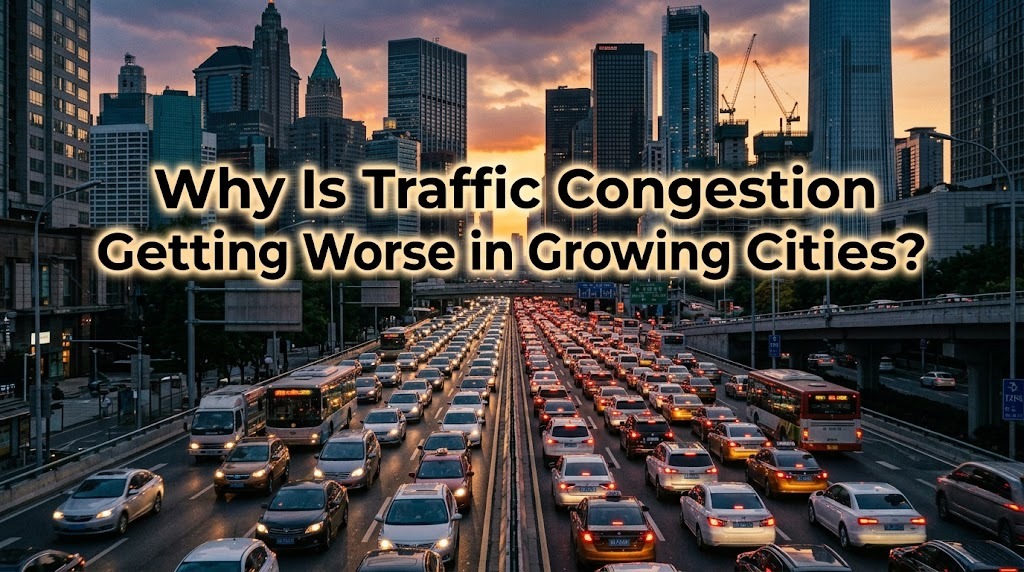
Traffic congestion is becoming a serious problem in many growing cities around the world. As urban populations increase, more people travel to work, school, shopping centers, and other destinations every day. However, the development of transportation infrastructure does not always keep pace with this growing demand. As a result, roads become crowded, travel times increase, and daily activities become less efficient. Understanding the main causes of urban traffic congestion is essential for finding practical and sustainable solutions.
RAPID POPULATION GROWTH AND URBANIZATION
One of the main reasons traffic congestion is getting worse in growing cities is rapid population growth. More people move to urban areas to find jobs, pursue education, access healthcare, and enjoy better public facilities. This process, known as urbanization, increases the demand for transportation and places additional pressure on existing roads. When the number of road users grows faster than transportation capacity, traffic congestion becomes increasingly difficult to control.
Growing populations also increase the number of daily trips between residential areas and city centers. Many people travel at similar times, particularly in the morning and evening, creating heavy traffic on major roads. In cities where housing and employment opportunities are concentrated in separate areas, residents may need to travel long distances every day. Without effective urban planning and accessible public transportation, population growth can significantly worsen traffic conditions.
INCREASING NUMBER OF PRIVATE VEHICLES
The growing use of private vehicles, including cars and motorcycles, is another major factor contributing to urban traffic congestion. Private transportation offers flexibility, comfort, and convenience, especially when public transportation is limited or unreliable. As household incomes increase, more people may choose to purchase personal vehicles. Consequently, the number of vehicles using urban roads can rise rapidly.
The problem becomes more serious when road capacity cannot accommodate the increasing number of vehicles. Cars also require more road space per passenger than buses carrying many people, particularly when they transport only one or two occupants. In addition, vehicles searching for parking spaces, stopping in restricted areas, or entering busy intersections can slow down traffic. Encouraging public transportation, carpooling, and other shared mobility options can help reduce dependence on private vehicles.
INSUFFICIENT PUBLIC TRANSPORTATION FACILITIES
Limited access to reliable public transportation can make traffic congestion worse in growing cities. When buses, trains, and other public transport services are unavailable, infrequent, overcrowded, or poorly connected, people are more likely to use private vehicles. This creates additional pressure on roads that may already operate near their maximum capacity. A lack of convenient transportation alternatives can therefore contribute to persistent traffic problems.
Effective public transportation should be affordable, safe, reliable, and accessible to residents across different neighborhoods. Cities can improve their services by expanding bus routes, developing integrated transport networks, increasing service frequency, and providing convenient connections between different modes of transportation. Dedicated bus lanes and reliable schedules can also make public transportation more attractive. When more residents choose public transport instead of driving individually, the number of vehicles on busy roads can decrease.
POOR URBAN PLANNING AND ROAD INFRASTRUCTURE
Poor urban planning can contribute significantly to traffic congestion, particularly when residential areas, offices, schools, and commercial centers develop without proper coordination. If essential destinations are far apart, residents must travel longer distances to complete their daily activities. This increases the number of vehicles on major roads and creates heavier traffic during peak hours. Unplanned development can also produce bottlenecks where several busy routes meet.
Inadequate road maintenance, poorly designed intersections, limited parking facilities, and a lack of alternative routes can further reduce traffic efficiency. However, simply building wider roads does not always provide a lasting solution because additional road capacity may encourage more people to drive. A more sustainable approach combines integrated urban planning, efficient public transportation, pedestrian-friendly neighborhoods, and safe cycling infrastructure. These measures can reduce unnecessary travel and provide residents with more transportation choices.
ECONOMIC GROWTH AND CHANGING TRAVEL PATTERNS
Economic growth can improve living standards while also increasing transportation demand. As businesses expand and employment opportunities grow, more workers travel to offices, industrial areas, and commercial districts. Higher purchasing power can also increase vehicle ownership and spending on goods and services that require transportation. When these changes occur faster than improvements in transportation systems, congestion may become more severe.
Changing work and lifestyle patterns can add to the problem. Many employees follow similar working hours, while students travel to schools and universities during the same morning period. Delivery vehicles, ride-hailing services, and commercial transportation can create additional pressure on busy streets, especially when loading and unloading areas are inadequate. Cities can address these challenges through flexible working hours, better delivery management, improved traffic information systems, and policies that distribute travel demand more evenly throughout the day.
KESIMPULAN
Traffic congestion in growing cities is becoming worse because of rapid urbanization, increasing private vehicle ownership, inadequate public transportation, poor urban planning, and rising economic activity. These factors often interact, making congestion difficult to solve through a single policy. Building more roads alone may not provide a long-term solution if the number of vehicles continues to increase.
Cities need a comprehensive and sustainable transportation strategy that improves public transportation, supports walking and cycling, strengthens urban planning, and manages traffic more effectively. Governments, businesses, and residents must work together to encourage more efficient travel habits. By addressing the underlying causes of congestion, growing cities can improve mobility, reduce pollution, save travel time, and create a better quality of life for their communities.
Recent Posts

Bagaimana Sistem SKS pada Program Kuliah... 22.11.2026/54 View

How Does Technology Make Daily Evaluation... 21.11.2026/83 View

Apa Strategi Menghadapi Kesenjangan antara Kompetensi... 21.11.2026/81 View

Mengapa Inventaris Aset Penting bagi Kelancaran... 21.11.2026/78 View

When Should Musicians Join a Record... 21.11.2026/82 View
