

Why Is Visual Intelligence Important for Understanding Images and Information?
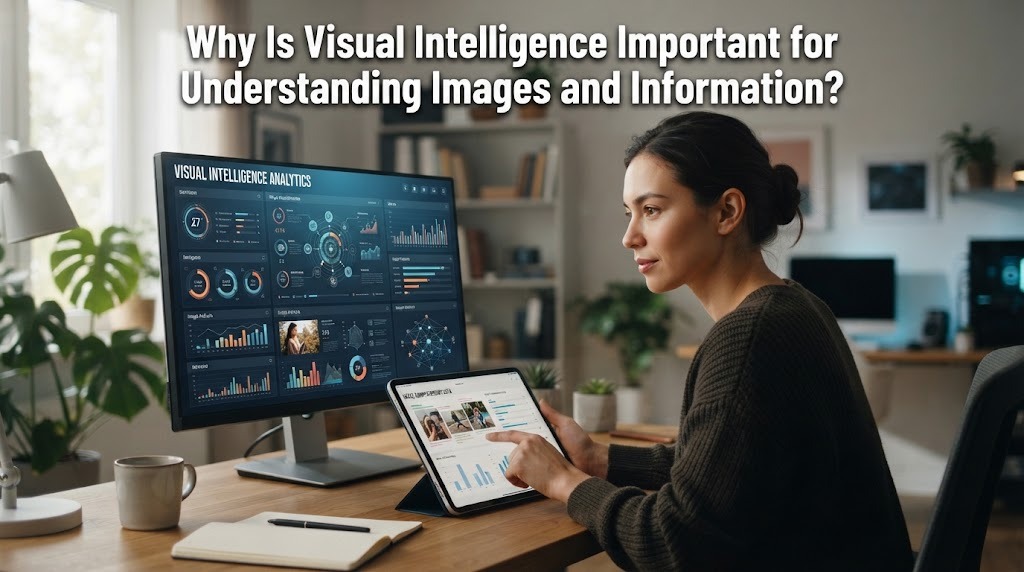
Visual intelligence is the ability to understand, process, and remember information through images, shapes, colors, patterns, and spatial relationships. In everyday life, people encounter visual information through books, websites, maps, charts, videos, advertisements, and digital applications. Visual intelligence helps people understand these forms of information more clearly and efficiently.
This ability is useful in both education and daily activities. Students may use visual intelligence when reading diagrams or interpreting graphs, while professionals may use it when analyzing presentations or designing visual content. Understanding the role of visual intelligence can help people become more effective when working with different types of information.
WHAT IS VISUAL INTELLIGENCE?
Visual intelligence refers to the ability to understand and work with information that is presented visually. It includes skills such as recognizing shapes, identifying patterns, remembering images, understanding space, and mentally visualizing objects. These skills allow people to interpret what they see and connect visual information with existing knowledge.
Visual intelligence is different from simply having good eyesight. Seeing an image is only the first step, while visual intelligence involves understanding what the image means. For example, someone may look at a graph but need visual thinking skills to recognize trends, compare values, and understand the message presented by the data.
HOW VISUAL INTELLIGENCE HELPS UNDERSTAND IMAGES
Images can communicate ideas quickly, but their meaning may depend on details and relationships between visual elements. Visual intelligence helps people identify important objects, colors, shapes, positions, and patterns within an image. This can make it easier to understand the message that an image is trying to communicate.
For example, students may use visual intelligence when interpreting illustrations in textbooks or understanding scientific diagrams. People can also use it when reading signs, recognizing symbols, or analyzing photographs. The ability to notice visual details can lead to a more accurate understanding of images.
VISUAL INTELLIGENCE AND INFORMATION PROCESSING
Many types of information are presented through visual formats such as charts, graphs, tables, infographics, and diagrams. Visual intelligence helps people organize the elements they see and understand how they are connected. This can make complex information easier to process.
For instance, a chart can show changes over time more clearly than a long written explanation. A diagram can also explain the relationship between different parts of a system. Visual thinking allows people to recognize patterns and connections that may not be immediately obvious in written information.
BENEFITS FOR LEARNING AND MEMORY
Visual intelligence can support learning because visual materials can help learners organize and remember information. Mind maps, diagrams, timelines, illustrations, and charts can provide a visual structure for important ideas. This can make lessons easier to review and understand.
Visual information can also create meaningful associations in memory. When a concept is connected to a particular image, shape, or diagram, learners may find it easier to recall the information later. Combining visual learning with reading, writing, and practice can create a more complete learning experience.
VISUAL INTELLIGENCE AND PROBLEM SOLVING
Understanding visual information can also support problem solving. When people can visualize a problem, they may be able to identify relationships, patterns, and possible solutions more easily. This is especially useful for problems involving shapes, locations, processes, or multiple pieces of information.
For example, maps can help people determine directions, while diagrams can help explain how a machine or system works. Visualizing different possibilities can help people approach problems from more than one perspective. This makes visual intelligence useful in academic, professional, and everyday situations.
HOW TO IMPROVE VISUAL INTELLIGENCE
Visual intelligence can be developed through regular activities that require observation and visual thinking. Drawing, puzzles, photography, mind mapping, reading maps, interpreting charts, and identifying patterns are simple ways to practice. These activities encourage people to pay attention to details and understand relationships between visual elements.
It is also helpful to question what you see instead of simply looking at it. Ask what the image represents, which details are important, and how different elements are connected. Regular visual practice can gradually improve observation, visual memory, spatial awareness, and information processing skills.
CONCLUSION
Visual intelligence is important because people encounter visual information almost everywhere. It helps individuals understand images, recognize patterns, process charts and diagrams, remember information, and solve visual problems. These abilities can support learning, communication, creativity, and everyday decision making.
Developing visual intelligence does not require complicated training. Simple activities such as drawing, puzzles, mind mapping, photography, and analyzing visual information can provide useful practice. By improving visual thinking skills, people can become better at understanding both images and the information communicated through them.
Recent Posts

Bagaimana Sistem SKS pada Program Kuliah... 22.11.2026/21 View

How Does Technology Make Daily Evaluation... 21.11.2026/64 View

Apa Strategi Menghadapi Kesenjangan antara Kompetensi... 21.11.2026/65 View

Mengapa Inventaris Aset Penting bagi Kelancaran... 21.11.2026/62 View

When Should Musicians Join a Record... 21.11.2026/61 View
