

Why Is Visual Intelligence Important in the Digital Era?
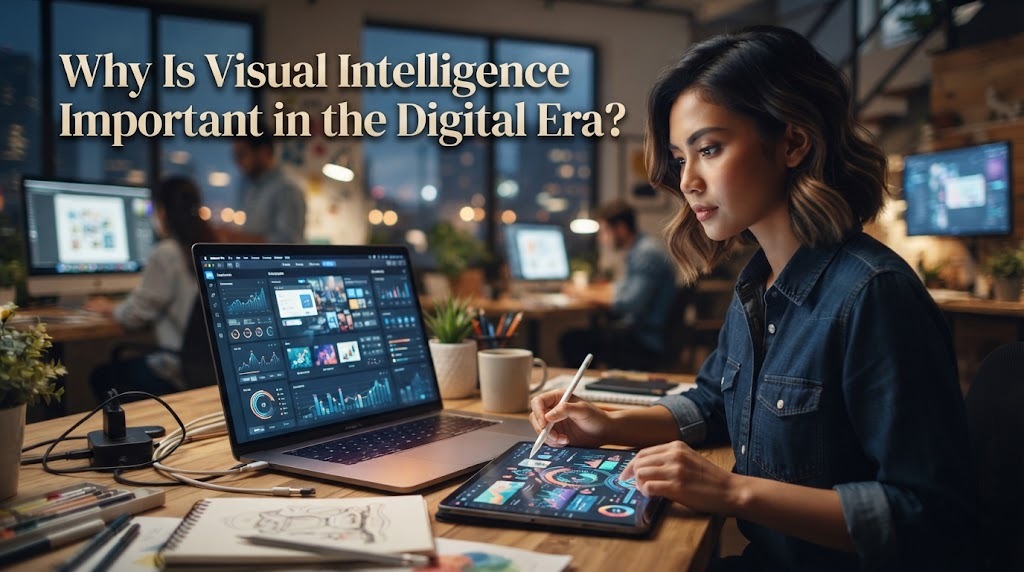
Visual intelligence is the ability to understand, interpret, organize, and remember visual information. In the digital era, this ability has become increasingly relevant because people interact with images, videos, graphics, charts, interfaces, and digital content every day. Smartphones, websites, social media, online learning platforms, and workplace applications all rely heavily on visual communication. As a result, strong visual intelligence can help people understand and use digital information more effectively.
Digital technology has also changed the way information is presented. Instead of relying only on long written explanations, many platforms use infographics, icons, animations, dashboards, and visual presentations to communicate ideas. Understanding these elements requires more than simply seeing them because users need to interpret their meaning and identify the information that matters.
VISUAL INTELLIGENCE HELPS PEOPLE PROCESS DIGITAL INFORMATION
People encounter large amounts of digital information throughout the day. News websites, social media platforms, online courses, applications, and business tools often combine text with visual elements. Visual thinking can help users identify important patterns, compare information, and understand relationships between different elements.
For example, a dashboard may contain several charts showing different types of data. A person with developed visual skills can examine the layout, labels, shapes, and patterns to understand what the information represents. This makes visual information processing an important skill in modern digital environments.
SUPPORTS DIGITAL LEARNING
Digital learning frequently uses visual materials to explain concepts. Videos, diagrams, presentations, animations, digital illustrations, and interactive simulations can help students explore information in different ways. Visual intelligence allows learners to interpret these materials and connect visual information with concepts they are studying.
For example, a biology lesson may use an animation to show how a process occurs inside the human body. A mathematics lesson may use graphs or geometric models to demonstrate relationships between numbers and shapes. When students can understand these visual representations, they can engage more effectively with digital learning content.
IMPROVES DIGITAL COMMUNICATION
Visual communication has become an important part of how people share information online. Social media posts, presentations, websites, advertisements, and professional reports often use images, icons, charts, and layouts to communicate messages. Visual intelligence helps people understand what these elements are intended to communicate.
It can also help people create clearer digital content. Someone designing a presentation needs to consider the position of text, images, spacing, and visual hierarchy. Understanding these relationships can make information easier for others to follow. Therefore, visual communication skills are useful for both consuming and creating digital content.
HELPS PEOPLE UNDERSTAND DATA AND INFORMATION
Modern workplaces increasingly use digital dashboards, graphs, reports, and data visualizations. These tools can present large amounts of information in a compact format. Visual intelligence can help users recognize trends, comparisons, patterns, and relationships within these representations.
For example, a sales dashboard may use several charts to show changes in performance over time. Employees need to understand labels, scales, colors, and positions to interpret the information correctly. Developing data visualization skills can therefore support better understanding of information in academic and professional settings.
SUPPORTS DIGITAL DESIGN AND CREATIVE WORK
The digital era has created many opportunities in fields such as graphic design, photography, video editing, animation, web design, and content creation. These activities require people to understand composition, proportion, color, space, movement, and visual hierarchy.
Visual intelligence can help creators imagine how different elements will work together before producing the final result. For example, a video editor may consider how images, text, transitions, and sound should be arranged to communicate an idea. Strong visual thinking skills can support the creative process across many digital fields.
HELPS PEOPLE NAVIGATE DIGITAL INTERFACES
Digital interfaces depend on visual cues to guide users. Icons, buttons, menus, symbols, colors, and screen layouts help people understand how applications and websites work. Users need to recognize these elements and understand their relationships to perform tasks efficiently.
For example, a person may identify a search icon, recognize a notification symbol, or understand that an arrow indicates movement to another page. These simple interactions involve visual recognition and spatial awareness. As digital platforms continue to become part of everyday life, understanding visual interfaces remains increasingly useful.
HOW CAN VISUAL INTELLIGENCE BE DEVELOPED?
Visual intelligence can be developed through regular activities that require observation, interpretation, and spatial thinking. Drawing, photography, puzzles, mind mapping, diagram analysis, data visualization, and design exercises can provide useful practice. People can also improve their skills by examining digital interfaces and asking how different visual elements communicate information.
It is also useful to practice turning complex information into simple visual formats. For example, a long explanation can be transformed into a flowchart or mind map. A collection of numbers can be organized into a simple chart. These activities encourage people to think about how information can be organized and communicated visually.
CONCLUSION
Visual intelligence is important in the digital era because people constantly interact with images, videos, charts, interfaces, graphics, and other forms of visual information. It can support digital learning, communication, data interpretation, creativity, and everyday technology use. These skills are relevant not only to creative professionals but also to students, employees, and general technology users.
Developing visual intelligence does not require specialized training. Activities such as analyzing diagrams, creating mind maps, solving visual puzzles, studying charts, and practicing digital design can strengthen visual thinking. As digital information continues to become an important part of everyday life, the ability to understand and communicate visually can be a valuable skill for learning and work.
Recent Posts

Bagaimana Sistem SKS pada Program Kuliah... 22.11.2026/21 View

How Does Technology Make Daily Evaluation... 21.11.2026/63 View

Apa Strategi Menghadapi Kesenjangan antara Kompetensi... 21.11.2026/65 View

Mengapa Inventaris Aset Penting bagi Kelancaran... 21.11.2026/62 View

When Should Musicians Join a Record... 21.11.2026/59 View
