

Why Must Voice-Controlled Robots Handle Speech Recognition Errors?
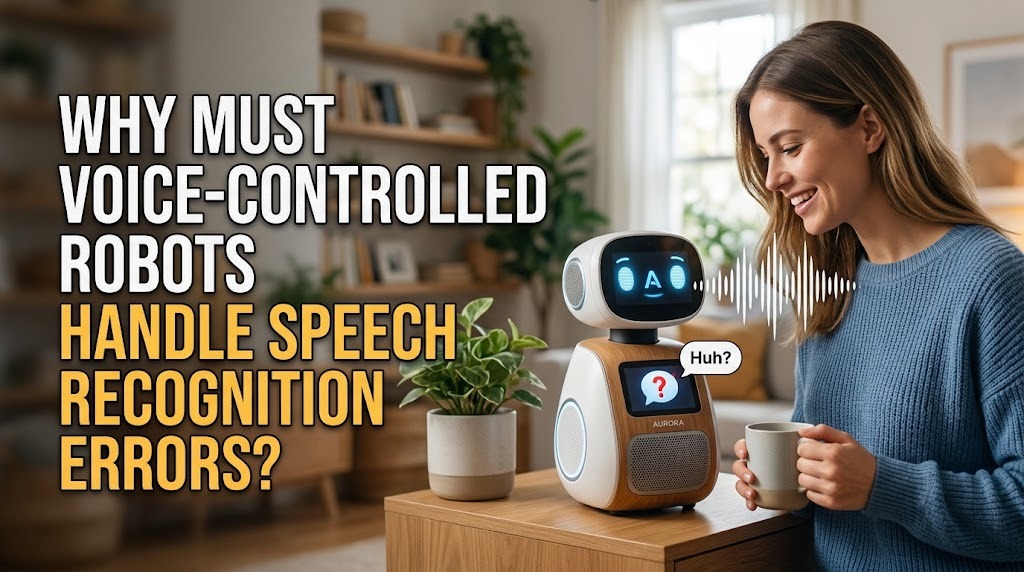
Voice-controlled robots allow users to interact with machines through spoken commands instead of relying entirely on buttons, keyboards, or touchscreens. These robots are used in homes, factories, hospitals, warehouses, and customer service environments. However, speech recognition systems can misunderstand words because of background noise, unclear pronunciation, accents, or technical limitations. Handling these errors is essential to ensure that robots respond safely, accurately, and reliably.
PREVENTING INCORRECT ROBOT ACTIONS
Speech recognition errors can cause robots to perform actions that users never intended. For example, a warehouse robot might interpret a command to stop as a different instruction and continue moving. In industrial environments, such misunderstandings could damage equipment or create safety hazards. Robots should therefore verify uncertain commands before executing actions that could have serious consequences. Reliable error handling helps ensure that robot behavior matches the user's actual intention.
IMPROVING COMMUNICATION ACCURACY
Voice-controlled robots depend on speech recognition systems to convert spoken language into machine-readable instructions. These systems may struggle with unfamiliar vocabulary, similar-sounding words, or incomplete sentences. Error-handling mechanisms can identify uncertain results and request clarification from the user. For instance, a robot may repeat the recognized command and ask whether the interpretation is correct. This process reduces misunderstandings and improves the accuracy of human-robot communication.
MANAGING BACKGROUND NOISE AND ACCENTS
Robots often operate in environments where background sounds interfere with speech recognition. Factory machinery, conversations, traffic, and ventilation systems can make spoken commands difficult to understand. Differences in pronunciation, speaking speed, and regional accents may create additional challenges. Noise-reduction techniques, microphone arrays, and speech models trained on diverse voices can improve recognition performance. However, robots should still recognize when the available audio is too unclear to support a confident decision.
MAINTAINING SAFETY IN CRITICAL SITUATIONS
Safety is especially important when robots control heavy equipment, transport materials, or interact physically with people. A misinterpreted voice command could trigger an unintended movement or prevent a robot from responding appropriately. Systems should apply stricter verification rules to high-risk actions and provide independent safety mechanisms where necessary. Emergency stops and protective sensors should not depend solely on speech recognition. Combining voice control with reliable hardware safeguards helps reduce the consequences of recognition failures.
BUILDING USER TRUST AND CONFIDENCE
People are more likely to trust robots when they respond consistently and explain what happens after a command is misunderstood. Repeated errors without feedback can frustrate users and make the technology difficult to operate. Robots can improve the experience by acknowledging commands, indicating uncertainty, and offering simple ways to correct mistakes. Clear verbal feedback helps users understand whether an instruction was accepted or rejected. These features make interactions more predictable and accessible.
USING CONTEXT TO INTERPRET COMMANDS
Context-aware systems can use information about the current task, environment, and previous instructions to interpret ambiguous speech. For example, a service robot operating in a hospital may use the current workflow to distinguish between similar requests. Natural language processing can also help identify the intended meaning of incomplete or conversational commands. However, context should not be treated as proof that an uncertain instruction is correct. Robots must request confirmation whenever an incorrect interpretation could create significant risk.
LEARNING FROM RECOGNITION ERRORS
Speech recognition errors can provide useful information for improving robotic systems. Developers can analyze anonymized error patterns, identify frequently misunderstood commands, and improve speech models or interface design. Testing with different speakers, accents, acoustic conditions, and command structures can reveal weaknesses before deployment. Systems may also adapt to individual users when appropriate consent and privacy protections are in place. Continuous evaluation helps maintain reliable performance as operating environments and user needs change.
PROVIDING CLEAR ERROR RECOVERY OPTIONS
A reliable voice-controlled robot should offer a simple recovery process when it fails to understand a command. It may ask the user to repeat the instruction, suggest alternative wording, or display the recognized phrase on a screen. For complicated tasks, the robot can break the command into smaller steps and confirm important details before proceeding. If communication repeatedly fails, switching to buttons, a touchscreen, or manual control may be appropriate. These alternatives prevent one recognition error from interrupting the entire task.
CONCLUSION
Voice-controlled robots must handle speech recognition errors because misunderstandings can affect safety, task accuracy, productivity, and user confidence. Noise filtering, contextual interpretation, confirmation requests, and clear recovery options help robots respond more reliably. For high-risk operations, voice recognition should be supported by independent safety mechanisms rather than used as the only control method. Effective error handling makes human-robot interaction safer, more practical, and more dependable.
Recent Posts

Bagaimana Sistem SKS pada Program Kuliah... 22.11.2026/49 View

How Does Technology Make Daily Evaluation... 21.11.2026/76 View

Apa Strategi Menghadapi Kesenjangan antara Kompetensi... 21.11.2026/78 View

Mengapa Inventaris Aset Penting bagi Kelancaran... 21.11.2026/74 View

When Should Musicians Join a Record... 21.11.2026/78 View
