

Why Should Governments Protect Historic Buildings?
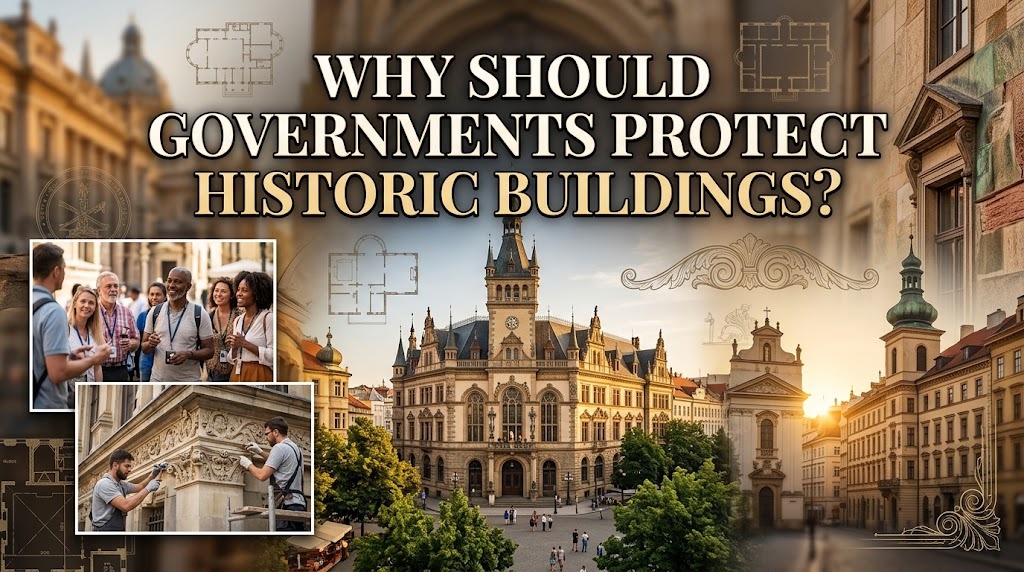
Historic buildings preserve important evidence of a country's past. They reflect architectural development, cultural traditions, social changes, and events that have shaped communities over generations. From former government offices and railway stations to traditional houses and religious monuments, these structures help people understand how societies developed and how earlier generations lived.
Government protection of historic buildings is important because many old structures cannot easily be replaced once their original features or historical significance are lost. Governments can establish preservation policies, provide funding, enforce regulations, and work with communities to maintain these valuable places. Through responsible conservation, historic buildings can continue contributing to education, cultural identity, and tourism.
PRESERVING NATIONAL HISTORY AND CULTURAL IDENTITY
One major reason governments should protect historic buildings is their connection to national and local history. These structures may be associated with important political events, social movements, traditional practices, or the development of public institutions. Their physical presence helps people connect historical accounts with actual places and architectural features.
Historic buildings can also strengthen cultural identity by representing the traditions and experiences of particular communities. Traditional houses, royal palaces, temples, mosques, and colonial-era buildings can each reveal different aspects of a region's past. By protecting these places, governments help preserve historical evidence and cultural references that may otherwise disappear through neglect or uncontrolled redevelopment.
SUPPORTING EDUCATION AND HISTORICAL RESEARCH
Historic buildings provide valuable resources for students, teachers, researchers, and the wider public. Their architectural designs, construction materials, inscriptions, and original functions can reveal information about earlier technologies and social conditions. Direct observation of these features can complement information found in books and other historical records.
Government support can make these sites more accessible for historical education and research. Preservation programs may include documentation, exhibitions, guided visits, educational materials, and cooperation with universities or heritage organizations. These activities allow people to study the past while encouraging respect for historical evidence. Protecting buildings also helps ensure that future researchers can examine their original features and learn from them.
ENCOURAGING TOURISM AND LOCAL ECONOMIC ACTIVITY
Well-preserved historic buildings can become important destinations for cultural heritage tourism. Visitors may travel to see distinctive architecture, learn about historical events, explore museums, or experience local traditions. Historic districts can also encourage visitors to discover nearby cultural attractions and local businesses.
Government involvement can help develop tourism responsibly through infrastructure improvements, visitor management, accurate historical interpretation, and conservation planning. Tourism may create opportunities for guides, craftspeople, food vendors, transport providers, and other local businesses. However, economic benefits are not automatic. Governments need to balance visitor activity with the protection of historic structures so that commercial development does not damage the heritage that attracts people in the first place.
PREVENTING DAMAGE AND UNCONTROLLED DEVELOPMENT
Historic buildings can deteriorate because of weather, humidity, pollution, structural problems, poor maintenance, or inappropriate alterations. They may also be threatened by demolition and redevelopment when their historical value is not adequately considered. Once important architectural details or original materials are destroyed, restoring the building to its earlier condition can be difficult or impossible.
Governments can reduce these risks through historic preservation laws, building assessments, maintenance programs, and appropriate development controls. In Indonesia, Law No. 11 of 2010 concerning Cultural Heritage provides a legal framework for protecting cultural heritage that meets the applicable criteria and designation requirements. Government agencies can also work with property owners, experts, and local communities to identify risks and plan suitable conservation measures.
PROMOTING RESPONSIBLE AND SUSTAINABLE PRESERVATION
Protecting historic buildings requires more than keeping their exterior appearance intact. Effective preservation involves understanding a building's historical significance, maintaining its structure, and managing changes carefully. Restoration work should be based on reliable research and appropriate conservation methods to avoid removing features that contribute to the building's value.
Governments can encourage sustainable historic preservation by providing technical guidance, supporting conservation training, and involving local communities in decision-making. Some historic buildings can continue serving useful functions as museums, cultural centers, public offices, or educational spaces when changes are carefully managed. Combining suitable modern uses with conservation can help maintain buildings over time while keeping them connected to community life.
CONCLUSION
Governments should protect historic buildings because they preserve national history, strengthen cultural identity, support education and research, and provide opportunities for responsible tourism. These structures contain architectural and historical information that cannot always be recovered if a building is neglected or destroyed. Government policies, funding, and cooperation with communities can help ensure that significant buildings receive appropriate care.
Protecting historic buildings also requires long-term planning and public participation. Through effective regulations, careful restoration, regular maintenance, and responsible use, governments can safeguard these places while allowing communities to benefit from them. Historic building preservation is therefore an investment in cultural knowledge and the ability of future generations to understand and appreciate the past.
Recent Posts

Bagaimana Sistem SKS pada Program Kuliah... 22.11.2026/51 View

How Does Technology Make Daily Evaluation... 21.11.2026/81 View

Apa Strategi Menghadapi Kesenjangan antara Kompetensi... 21.11.2026/81 View

Mengapa Inventaris Aset Penting bagi Kelancaran... 21.11.2026/77 View

When Should Musicians Join a Record... 21.11.2026/82 View
