

Why Should Regional Languages Be Taught in Formal Education?
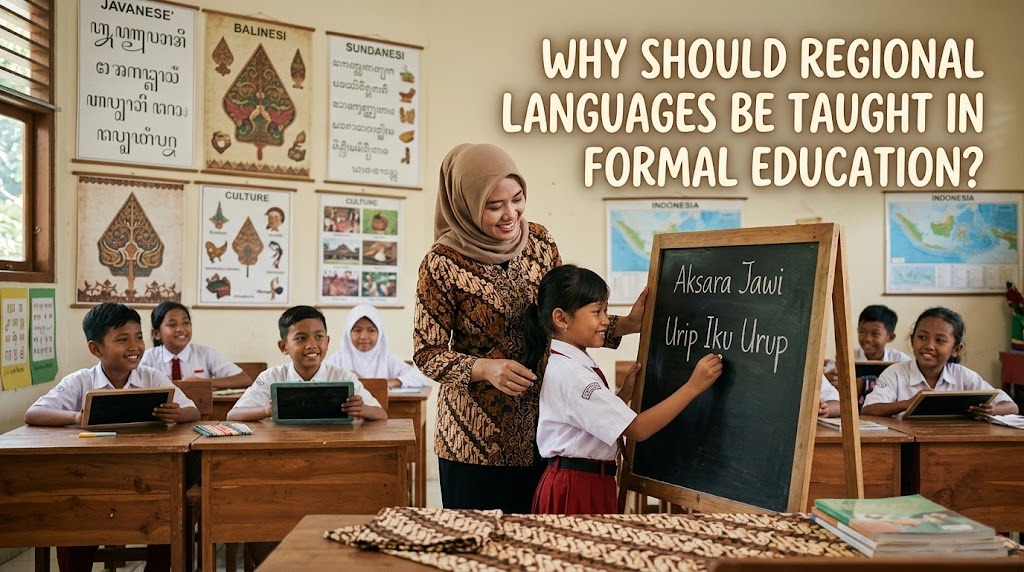
Regional languages are an important part of Indonesia’s cultural heritage because they reflect the history, identity, and traditions of different communities. With hundreds of regional languages across the archipelago, Indonesia has a rich linguistic diversity that deserves to be protected. However, some regional languages are becoming less commonly used by younger generations as Indonesian and global languages play a larger role in everyday communication. Formal education can help address this challenge by providing students with opportunities to learn, understand, and practice their local languages. Teaching regional languages in schools helps preserve cultural heritage while strengthening students’ understanding of their own communities.
REGIONAL LANGUAGES PRESERVE CULTURAL HERITAGE
Regional languages carry cultural knowledge that has been passed down from one generation to another. They contain traditional expressions, proverbs, stories, songs, and vocabulary that reflect the experiences of local communities. When students learn these languages at school, they gain opportunities to understand the cultural meanings behind words and expressions. This learning can help them appreciate the traditions and histories that shape their communities.
Schools can introduce regional-language lessons through reading materials, storytelling, traditional songs, and discussions about local customs. Teachers can also invite students to collect stories from parents or grandparents and present them in class. These activities connect classroom learning with real cultural experiences. Regional-language education helps ensure that local traditions remain meaningful to younger generations. By learning the language and its cultural context together, students can develop a stronger appreciation for Indonesia’s diverse heritage.
REGIONAL LANGUAGES STRENGTHEN CULTURAL IDENTITY
Learning a regional language can help students understand their family backgrounds and cultural identities. Language is closely connected to the way people express respect, maintain relationships, and participate in community life. By learning the language spoken by their parents or grandparents, students may develop a stronger sense of belonging. This connection can be especially meaningful for children who live far from their ancestral communities.
Formal education can provide a supportive environment for students to explore their cultural roots without feeling embarrassed about speaking a regional language. Teachers can explain the value of linguistic diversity and encourage students to share words or expressions from their communities. Such activities can promote mutual respect among students from different backgrounds. A strong cultural identity can coexist with an appreciation for other languages and traditions. Regional-language lessons can therefore help students value their own heritage while respecting the diversity of their classmates.
REGIONAL LANGUAGES SUPPORT COMMUNICATION BETWEEN GENERATIONS
Regional languages often serve as important communication tools within families and local communities. Parents, grandparents, and older community members may use them to share advice, stories, experiences, and traditional knowledge. When younger people no longer understand these languages, communication across generations can become more difficult. School-based learning can help students develop the skills needed to communicate with older family members.
Teachers can support this goal by introducing everyday expressions, common vocabulary, greetings, and conversations that students can use outside the classroom. Students can also interview relatives and practice speaking with them in their regional language. These experiences make language learning more practical and personally meaningful. Learning regional languages can strengthen family relationships by giving younger people more ways to communicate with older generations. When students use the language regularly at home, their skills are more likely to develop beyond the classroom.
REGIONAL LANGUAGES DEVELOP LANGUAGE AND LEARNING SKILLS
Studying a regional language can help students understand how languages work and how communication changes according to context. They can compare vocabulary, pronunciation, sentence structures, and expressions of politeness with Indonesian or other languages they know. These comparisons may encourage students to think carefully about meaning and word choice. They can also develop listening, speaking, reading, and writing skills when the language has an established written form and suitable learning materials.
Regional-language lessons can provide opportunities for creative learning through dialogue, storytelling, presentations, songs, and short written assignments. Students may become more confident when explaining ideas in a language connected to their everyday experiences. Teachers can adapt activities to students’ proficiency levels and the local language variety used in their communities. Learning more than one language can broaden students’ communication skills and their understanding of linguistic diversity. These benefits are strongest when lessons are interactive, inclusive, and connected to practical situations.
SCHOOLS HELP PREVENT REGIONAL LANGUAGES FROM DISAPPEARING
Some regional languages face declining use because fewer children learn them as their first language or use them regularly at home. When a language has fewer young speakers, its future may become uncertain. Schools can help address this issue by giving students structured opportunities to learn and practice the language. Formal education can also raise awareness of why language preservation matters.
Effective programs require appropriate teaching materials, trained educators, and support from local communities. Schools can work with language experts, cultural organizations, and fluent speakers to develop lessons that reflect local conditions. Digital recordings, dictionaries, videos, and online learning resources can supplement classroom instruction. School-based education is most effective when it supports, rather than replaces, language use within families and communities. Combining formal lessons with everyday practice can give regional languages more opportunities to remain active across generations.
REGIONAL LANGUAGES PROMOTE RESPECT FOR CULTURAL DIVERSITY
Indonesia’s students come from communities with different languages, customs, and cultural experiences. Learning regional languages can help them understand that no single language represents the entire country’s cultural heritage. Students may explore how languages reflect local traditions, historical experiences, and different ways of expressing ideas. This knowledge can encourage curiosity and respect rather than prejudice toward people who speak differently.
Schools can organize language exhibitions, cultural performances, storytelling sessions, or collaborative projects that introduce students to regional languages from different parts of Indonesia. Such activities allow students to learn from one another and recognize the value of linguistic diversity. Teachers should also ensure that students who speak different regional languages feel included, rather than treating one local language as more valuable than others. Respect for regional languages encourages appreciation of Indonesia’s cultural diversity and shared national identity. Education can help students understand that preserving local languages and communicating in Indonesian are complementary goals.
CONCLUSION
Regional languages should be taught in formal education because they preserve cultural heritage, strengthen cultural identity, support communication between generations, and develop students’ language skills. Schools also provide opportunities to raise awareness about languages that are becoming less widely used. Successful programs require relevant learning materials, supportive teachers, and cooperation between schools, families, and local communities. Regional-language lessons should encourage practical use and respect for different linguistic backgrounds. By integrating regional languages into education, Indonesia can help protect its cultural diversity and ensure that future generations remain connected to their linguistic heritage.
Recent Posts

Bagaimana Sistem SKS pada Program Kuliah... 22.11.2026/49 View

How Does Technology Make Daily Evaluation... 21.11.2026/76 View

Apa Strategi Menghadapi Kesenjangan antara Kompetensi... 21.11.2026/78 View

Mengapa Inventaris Aset Penting bagi Kelancaran... 21.11.2026/74 View

When Should Musicians Join a Record... 21.11.2026/78 View
