

Why Should Vocational Students Learn Industrial Robot Programming?
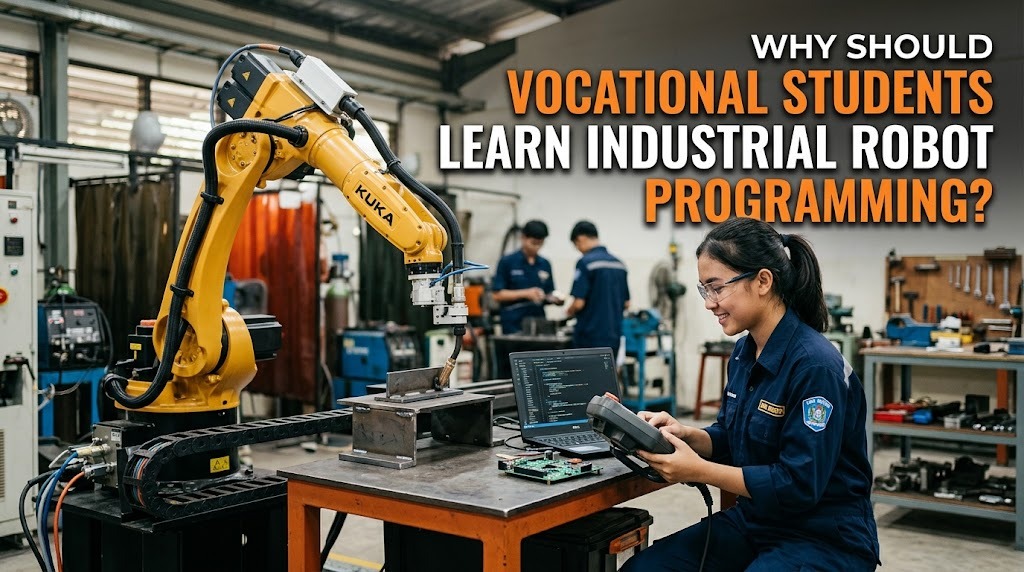
Industrial robots are widely used in manufacturing industries to perform tasks such as welding, assembly, packaging, painting, and material handling. As companies adopt more automated production systems, workers need technical skills to operate and maintain robotic equipment. For vocational students, learning industrial robot programming provides practical knowledge that can support their transition from school to the workplace. This skill also helps them understand how modern technology improves industrial productivity and product quality.
PREPARING FOR MODERN INDUSTRIAL WORKPLACES
Industrial robot programming helps vocational students understand how automated production systems operate. Students learn how robots follow programmed instructions to perform specific tasks accurately and repeatedly. They can also explore how robots interact with sensors, tools, controllers, and other machines on a production line. This knowledge prepares them to work in environments where automation is part of everyday operations. Early exposure to industrial robotics can also make workplace training easier to understand.
DEVELOPING PRACTICAL TECHNICAL SKILLS
Programming industrial robots requires students to combine theoretical knowledge with hands-on practice. They may learn coordinate systems, movement commands, tool positioning, and basic program logic. Practical exercises can include moving a robotic arm between programmed points or arranging objects in a particular sequence. These activities help students understand the relationship between instructions and physical movements. Regular practice also develops troubleshooting skills because students must identify and correct programming errors.
IMPROVING EMPLOYMENT OPPORTUNITIES
Employers in manufacturing and automation-related industries may seek workers who understand robotic equipment and automated processes. Vocational students with relevant programming experience can demonstrate their ability to perform tasks beyond basic machine operation. These skills may support career opportunities as robot operators, automation technicians, production technicians, or junior robotics programmers, depending on their qualifications and experience. Learning robot programming does not guarantee employment, but it can strengthen a student's technical portfolio. Combining robotics knowledge with internships, certifications, and practical projects can improve career readiness.
UNDERSTANDING INDUSTRY 4.0 TECHNOLOGY
Industry 4.0 connects automation, digital systems, sensors, data, and manufacturing equipment to create more integrated production environments. Industrial robots often work alongside programmable logic controllers, machine vision systems, and industrial communication networks. By studying robot programming, vocational students gain a foundation for understanding these connected technologies. They can learn how robots receive commands, exchange signals, and respond to production requirements. This knowledge helps students adapt as manufacturing systems become increasingly digital and interconnected.
STRENGTHENING PROBLEM-SOLVING AND LOGICAL THINKING
Robot programming requires students to break complex tasks into smaller, manageable instructions. They must determine the correct movement sequence, identify potential collisions, and adjust parameters when a program produces unexpected results. This process encourages logical thinking, careful planning, and systematic problem-solving. Students also learn to test programs, evaluate outcomes, and make improvements. These abilities are useful not only in robotics but also in other technical occupations that involve diagnosing and solving operational problems.
LEARNING WORKPLACE SAFETY AND QUALITY CONTROL
Industrial robots can move quickly and carry heavy materials, making safe operation essential. Programming education teaches students to consider movement limits, emergency stops, protective barriers, and approved operating procedures. They also learn why programs should be tested carefully before a robot performs a task at full speed. In addition, students can examine how accurate robot movements support consistent production quality and reduce certain types of human error. Understanding both safety and quality control helps prepare students for responsible work in industrial environments.
SUPPORTING INNOVATION AND CAREER DEVELOPMENT
Learning industrial robot programming can encourage vocational students to explore new technical solutions. They may develop small projects involving automated sorting, pick-and-place operations, or simulated production lines. These projects allow students to apply classroom knowledge to practical manufacturing problems. They can also build a portfolio that demonstrates their skills to teachers, internship supervisors, and potential employers. With further training, students may continue into advanced automation, robotics maintenance, or industrial engineering technology.
GAINING EXPERIENCE WITH INDUSTRIAL SOFTWARE
Many industrial robots use specialized software for programming, simulation, and monitoring. Vocational students who practice with these tools can learn how to create robot paths, test movements virtually, and identify errors before operating physical equipment. Simulation is especially useful when schools have limited access to industrial robots or need to reduce equipment risks. Students should also become familiar with technical documentation and manufacturer-specific programming environments. These experiences can make the transition to real industrial systems more manageable.
CONCLUSION
Vocational students should learn industrial robot programming because it develops practical technical skills, strengthens problem-solving abilities, and prepares them for increasingly automated workplaces. It also introduces important concepts in Industry 4.0, workplace safety, quality control, and industrial software. Through hands-on projects and structured training, students can build a strong foundation for careers in manufacturing and automation. Learning these skills while still in school can help them become more adaptable and technically prepared for future employment.
Recent Posts

Bagaimana Sistem SKS pada Program Kuliah... 22.11.2026/48 View

How Does Technology Make Daily Evaluation... 21.11.2026/76 View

Apa Strategi Menghadapi Kesenjangan antara Kompetensi... 21.11.2026/78 View

Mengapa Inventaris Aset Penting bagi Kelancaran... 21.11.2026/73 View

When Should Musicians Join a Record... 21.11.2026/78 View
