

Why Should Young People Learn Their Regional Languages?
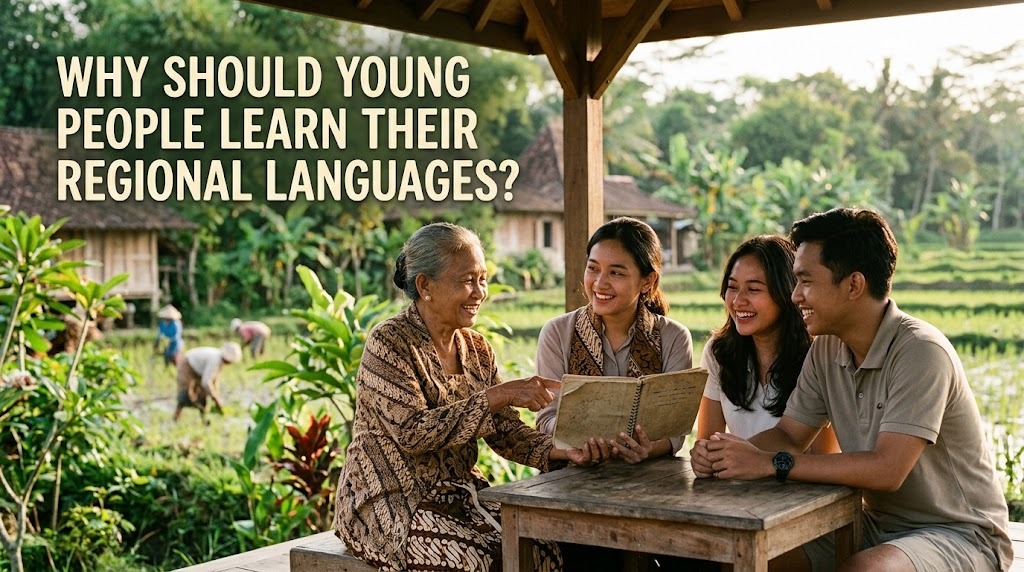
Regional languages are an important part of Indonesia's cultural heritage and everyday communication. Across the country, communities use different languages to share stories, express feelings, maintain traditions, and build relationships. However, many young people are becoming more familiar with Indonesian and foreign languages while using their regional languages less frequently. Learning a regional language can help young people reconnect with their families, understand local traditions, and appreciate Indonesia's linguistic diversity. Preserving regional languages is not only about protecting the past but also about keeping cultural knowledge alive for the future.
WHY ARE REGIONAL LANGUAGES IMPORTANT FOR YOUNG PEOPLE?
Regional languages help young people understand their cultural identity and the history of their communities. Each language contains distinctive vocabulary, expressions, and ways of communicating that reflect the experiences of its speakers. By learning their regional languages, young people can better understand the traditions and values passed down by older generations. They can also participate more confidently in family gatherings, community activities, and cultural celebrations. This knowledge helps them recognize the importance of their cultural background while respecting the diversity of other communities.
Learning a regional language can also strengthen communication between generations. Grandparents and older relatives may feel more comfortable expressing themselves in the languages they have used throughout their lives. When young people understand these languages, conversations can become more meaningful and personal. They can listen to family stories, learn traditional expressions, and ask questions about their ancestors' experiences. Regional languages help build stronger family connections and a deeper sense of belonging.
HOW CAN REGIONAL LANGUAGES STRENGTHEN CULTURAL IDENTITY?
Language is closely connected to cultural identity because it carries traditions, beliefs, stories, and social values. Regional languages often contain expressions that reflect local customs and ways of showing respect. Some words have meanings connected to particular ceremonies, family relationships, or community responsibilities. Learning these expressions allows young people to understand cultural practices beyond their outward appearance. It also helps them appreciate why certain traditions remain meaningful to their communities.
Regional languages are also important in traditional music, dance, theater, poetry, and storytelling. Many cultural performances use local expressions that communicate humor, emotion, historical experiences, or moral lessons. Young people who understand the language can appreciate these performances more fully and help introduce them to others. They may also create modern interpretations through music, films, or digital content while respecting the original cultural context. In this way, learning a regional language helps young people preserve their heritage while developing new ways to express it.
WHAT BENEFITS CAN YOUNG PEOPLE GAIN FROM LEARNING REGIONAL LANGUAGES?
Learning a regional language provides practical communication benefits. Young people can interact with relatives, neighbors, and community members who prefer speaking that language. It can also help them communicate more comfortably when visiting villages or regions where the language is commonly used. Understanding local expressions can make social interactions more natural and help prevent misunderstandings. These skills are particularly useful in a culturally diverse country such as Indonesia.
Learning more than one language can also increase awareness of how communication works. Young people can compare vocabulary, sentence structures, pronunciation, and expressions across languages. This experience may help them become more attentive to cultural differences and more flexible when communicating with others. Regional language knowledge can also be useful in fields such as education, tourism, cultural research, translation, and community development. Although learning a language does not guarantee academic or professional success, multilingual skills can broaden communication opportunities and support cultural understanding.
HOW CAN YOUNG PEOPLE LEARN THEIR REGIONAL LANGUAGES MORE EASILY?
Young people can begin by using simple regional expressions in everyday conversations. They can learn greetings, common questions, family terms, numbers, and vocabulary related to food or daily activities. Practicing with parents, grandparents, relatives, and fluent speakers helps them understand how words are used naturally. Listening carefully and repeating expressions can gradually improve pronunciation and confidence. Regular practice is more effective than learning vocabulary without using it in real conversations.
Digital technology also offers many opportunities to learn regional languages. Young people can watch educational videos, listen to regional songs, explore online dictionaries, and follow content creators who use their local languages. They can join cultural communities, participate in language-learning groups, or record conversations with relatives—with their permission—to review new expressions. Schools and local cultural organizations may also provide language classes, storytelling activities, or traditional arts programs. Combining digital resources with direct communication helps learners develop vocabulary, listening skills, and speaking confidence.
WHY SHOULD YOUNG PEOPLE HELP PREVENT REGIONAL LANGUAGES FROM DISAPPEARING?
Some regional languages face declining use because fewer children learn them as their first or additional language. When younger generations stop using a language, the community may gradually lose access to traditional stories, expressions, and knowledge associated with it. Young people can help prevent this decline by speaking their regional languages with family members and encouraging friends to learn common expressions. They can also create videos, podcasts, digital dictionaries, and educational posts that introduce their languages to wider audiences. These efforts can make regional languages more visible and relevant in modern communication.
Preservation should not be limited to online activities or occasional cultural celebrations. Languages remain active when people use them regularly at home, in community settings, and in appropriate educational activities. Young people can work with fluent speakers to document vocabulary and pronunciation accurately, especially when a language has few learning resources. They should also respect differences between local varieties and avoid treating one version as the only correct form when several varieties are recognized by the community. By combining everyday use, digital creativity, and respect for native speakers, young people can contribute to the long-term survival of regional languages.
CONCLUSION
Young people should learn their regional languages because these languages preserve cultural identity, strengthen family relationships, and maintain traditional knowledge. Learning a regional language also improves communication within local communities and can create opportunities in education, tourism, and cultural activities. Young people can develop their skills through daily conversations, traditional stories, language classes, and digital resources. More importantly, they can help ensure that regional languages continue to be used rather than becoming limited to historical records. By learning and using their regional languages, young people can protect Indonesia's linguistic diversity while keeping their cultural heritage alive for future generations.
Recent Posts

Bagaimana Sistem SKS pada Program Kuliah... 22.11.2026/48 View

How Does Technology Make Daily Evaluation... 21.11.2026/76 View

Apa Strategi Menghadapi Kesenjangan antara Kompetensi... 21.11.2026/78 View

Mengapa Inventaris Aset Penting bagi Kelancaran... 21.11.2026/73 View

When Should Musicians Join a Record... 21.11.2026/78 View
