

How Can Technology Help Develop Visual Intelligence?
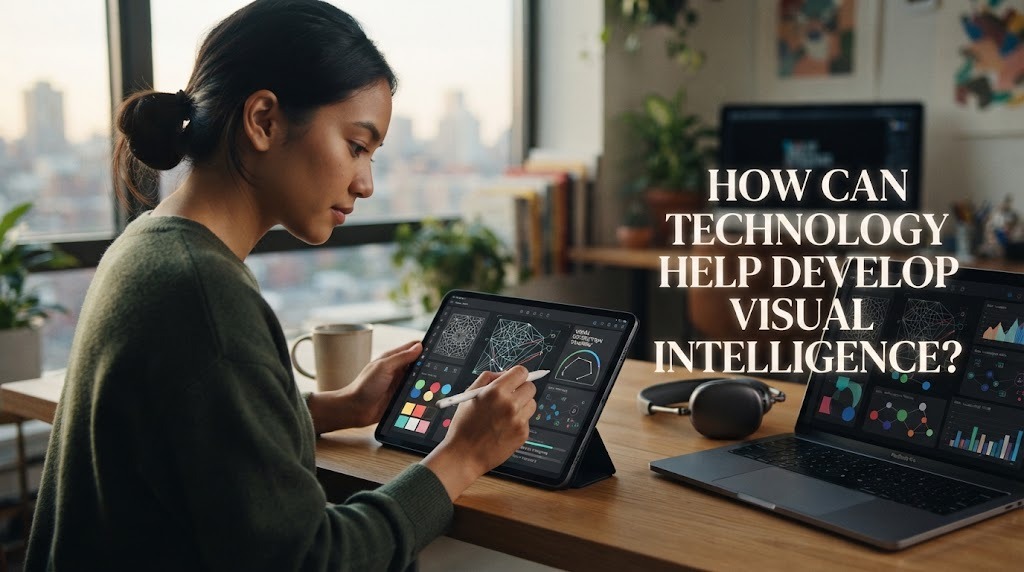
Technology has changed the way people learn, communicate, and understand information. Many digital tools use images, graphics, animations, maps, videos, and interactive designs that require users to process visual information. Using technology in the right way can help develop visual intelligence by encouraging observation, visualization, pattern recognition, and spatial thinking.
Visual intelligence is useful for students, professionals, and anyone who works with digital information. From educational applications to design software, technology provides many opportunities to practice visual skills. Understanding how these tools work can help people use technology not only for entertainment but also for meaningful learning and skill development.
WHAT IS VISUAL INTELLIGENCE?
Visual intelligence is the ability to understand and process information through images, shapes, colors, patterns, and spatial relationships. It helps people recognize objects, understand positions, imagine things mentally, and identify connections between visual elements. Visual thinking is an important part of learning and problem solving.
People use visual intelligence in many everyday activities. Reading maps, understanding charts, arranging objects, recognizing faces, and interpreting diagrams all require visual skills. Technology can provide additional opportunities to practice these abilities through interactive and visual activities.
HOW DIGITAL LEARNING TOOLS DEVELOP VISUAL SKILLS
Digital learning platforms often present information through images, diagrams, videos, animations, and interactive exercises. These formats can encourage learners to observe details and understand relationships between different visual elements. Visual learning tools can make abstract ideas easier to see and explore.
For example, students can use interactive diagrams to understand scientific processes or educational applications to explore mathematical shapes. Digital presentations can also combine text with images, charts, and illustrations. Regular interaction with these materials can help learners become more comfortable with processing visual information.
HOW GAMES SUPPORT VISUAL INTELLIGENCE
Digital games can provide activities that require players to recognize patterns, remember locations, solve puzzles, and understand spatial relationships. Puzzle games, building games, matching activities, and strategy games can encourage users to think visually while solving challenges. These activities can make visual practice more engaging and interactive.
Many games also require players to quickly identify objects or understand how different elements relate to each other. For example, a player may need to remember the location of an object or determine the correct position of several shapes. These tasks can provide opportunities to practice spatial awareness, visual memory, and pattern recognition.
HOW DESIGN SOFTWARE IMPROVES VISUAL THINKING
Technology also provides tools that allow people to create and manipulate visual content. Drawing applications, graphic design software, presentation tools, and 3D modeling programs can help users understand colors, shapes, proportions, composition, and space. Creating visual content can be an active way to develop visual intelligence.
When designing something digitally, users need to consider where objects should be placed and how different elements should work together. They may also need to compare sizes, adjust proportions, and visualize the final result. This process encourages people to think carefully about visual relationships rather than simply looking at individual objects.
HOW VIRTUAL AND INTERACTIVE TECHNOLOGY HELPS
Some technologies allow users to explore digital environments from different perspectives. Interactive maps, virtual environments, simulations, and 3D applications can help people understand distance, direction, movement, and spatial relationships. These experiences can provide practical opportunities to strengthen spatial thinking and mental visualization.
For example, a student can explore a virtual model of a building instead of only looking at a flat picture. An interactive map can also allow users to zoom in, rotate views, and understand relationships between different locations. These technologies can make spatial concepts more concrete and easier to explore.
HOW TO USE TECHNOLOGY EFFECTIVELY
Technology does not automatically improve visual intelligence simply because it contains images or graphics. The activity should require users to observe, analyze, create, compare, or solve visual problems. Active interaction is generally more useful for visual skill development than passive screen viewing.
People can practice by creating mind maps, solving digital puzzles, designing presentations, drawing illustrations, analyzing charts, or exploring interactive educational content. It is also useful to combine digital activities with offline experiences such as drawing, building, photography, and physical puzzles. This balanced approach can provide different ways to strengthen visual thinking.
CONCLUSION
Technology can provide many opportunities to develop visual intelligence through digital learning tools, games, design applications, interactive maps, simulations, and 3D environments. These technologies can encourage visual thinking, spatial awareness, pattern recognition, visual memory, and creative problem solving.
However, the way technology is used is important. Activities that require observation, creation, exploration, and problem solving can provide more meaningful visual practice than passive consumption. By using digital tools purposefully and combining them with real-world activities, people can gradually develop stronger visual intelligence.
Recent Posts

Apa Saja Keuntungan Mengambil Kuliah Cepat?... 23.11.2026/27 View

What Is a Joint Escrow Account... 23.11.2026/9 View

Why Are Escrow Services Important for... 23.11.2026/8 View

How Can Buyers Use Escrow Accounts... 23.11.2026/7 View

What Are the Main Benefits of... 23.11.2026/6 View
